

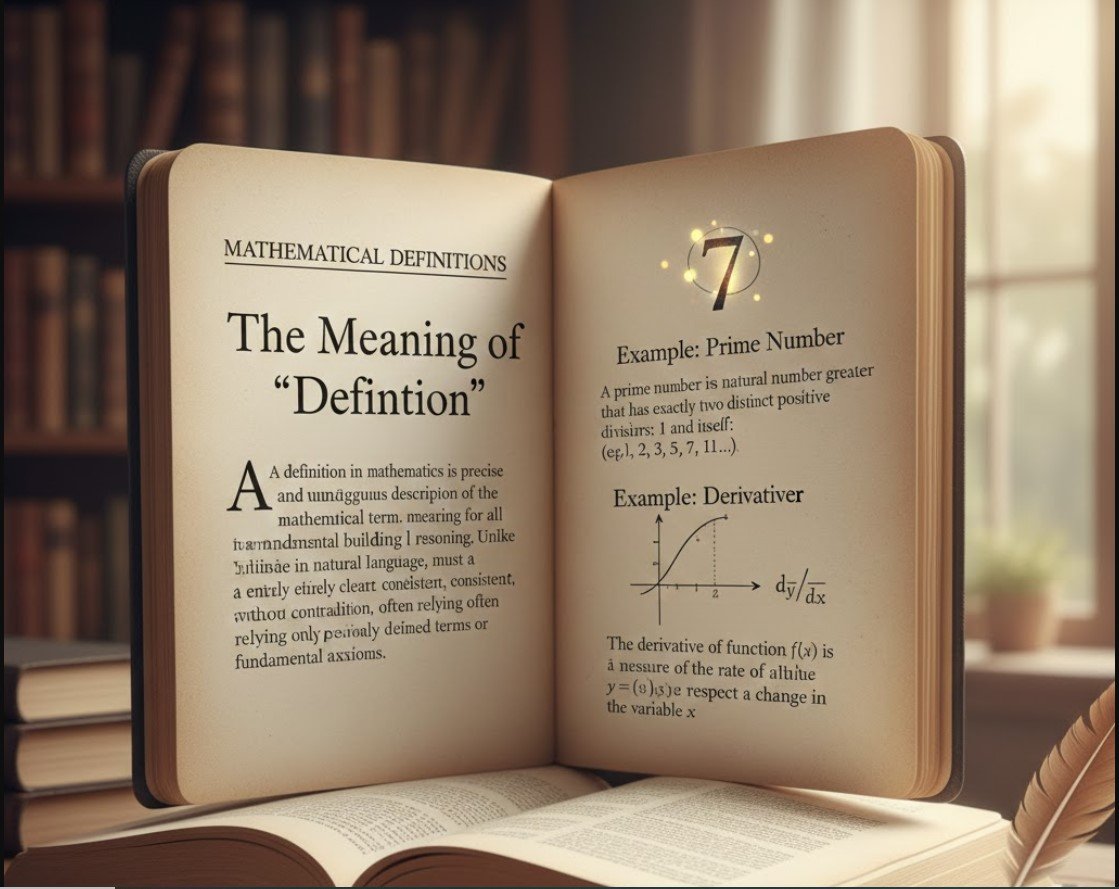
The meaning of definition in math goes far beyond a simple explanation of a word. In mathematics, a definition forms the backbone of logical reasoning, problem-solving, and theoretical development. Without clear definitions, mathematical communication would collapse into ambiguity and confusion. Every theorem, formula, proof, and equation depends on precisely defined terms.
Understanding the meaning of definition in math is essential for students, educators, researchers, and anyone interested in logical thinking. Mathematical definitions create structure, eliminate vagueness, and establish a shared language that allows ideas to be built layer by layer. From basic arithmetic to advanced calculus and abstract algebra, definitions guide every concept.
This in-depth article explores what a mathematical definition truly means, why it is critical to learning math, how definitions differ from everyday explanations, and how they shape mathematical reasoning. By the end, you will not only understand the meaning of definition in math but also appreciate its central role in building mathematical knowledge.
What Is the Meaning of Definition in Math?
The meaning of definition in math refers to a precise statement that explains the exact nature of a mathematical concept using clearly established terms. Unlike casual descriptions used in everyday conversation, mathematical definitions are strict, logical, and unambiguous.
In mathematics, a definition sets the boundaries of a concept. It tells us exactly what qualifies as an object and what does not. For example, a triangle is defined as a polygon with exactly three sides. This definition leaves no room for interpretation. A shape with four sides cannot be considered a triangle, no matter how similar it looks.
Mathematical definitions do not attempt to prove something. Instead, they introduce new terms or clarify existing ones. Once a definition is established, it becomes the foundation upon which theorems and proofs are constructed.
In essence, the meaning of definition in math centers on clarity, logical precision, and consistency.
Why Definitions Matter in Mathematics
Mathematics depends on structure. Without definitions, that structure would collapse. Every branch of mathematics begins by defining its basic objects.
Consider geometry. Before proving properties about circles, mathematicians define what a circle is. A circle is defined as the set of all points in a plane that are equidistant from a fixed point called the center. This definition provides exact criteria. It eliminates guesswork and ensures everyone interprets the concept identically.
Definitions prevent misunderstandings. In everyday language, words often have multiple meanings. In mathematics, a term has only one accepted meaning within a given context. This precision is crucial for logical reasoning.
The importance of understanding the meaning of definition in math becomes even clearer in higher mathematics. In calculus, the definition of a limit underpins the entire subject. In algebra, definitions of groups and fields establish entire systems of study. Without definitions, these advanced ideas could not exist.
How Mathematical Definitions Differ from Everyday Definitions
In ordinary language, definitions often rely on examples or general descriptions. For example, someone might define happiness as “feeling good.” This is subjective and open to interpretation.
Mathematics operates differently. Definitions must be exact and measurable. They must rely on previously defined terms. Each new concept is introduced carefully, building on established foundations.
For instance, the definition of a prime number states that it is a natural number greater than one that has no positive divisors other than one and itself. This definition leaves no ambiguity. A number either meets this criterion or it does not.
The meaning of definition in math therefore involves a higher standard of precision than most other disciplines. Mathematical definitions aim for absolute clarity, not approximation.
Types of Definitions in Mathematics
Understanding the meaning of definition in math requires exploring the different forms definitions can take. While all mathematical definitions share precision, they may be structured differently depending on context.
Explicit Definitions
An explicit definition directly states what a term means. For example, an even number is defined as an integer divisible by two. This definition clearly describes the property that qualifies a number as even.
Explicit definitions are common in algebra, geometry, and arithmetic because they clearly state the required conditions.
Implicit Definitions
Implicit definitions describe a concept through its relationships with other concepts. For example, subtraction can be implicitly defined in terms of addition. Rather than describing subtraction independently, it is defined through its connection to addition.
Implicit definitions are often used in advanced mathematics where relationships between structures matter more than standalone descriptions.
Recursive Definitions
A recursive definition defines an object in terms of itself, along with a base case. The factorial function provides a classic example. The factorial of zero is defined as one, and the factorial of a positive integer is defined as that integer multiplied by the factorial of the previous integer.
Recursive definitions are especially important in computer science, discrete mathematics, and number theory.
The Role of Definitions in Mathematical Proofs
Proof is central to mathematics, and definitions play a critical role in constructing proofs. A proof relies on definitions to determine whether statements are logically valid.
For example, suppose we want to prove that the sum of two even numbers is even. We begin with the definition of an even number. An even number is an integer that can be written as two times another integer. By applying this definition to both numbers and performing algebraic manipulation, we can demonstrate that their sum also fits the definition of an even number.
Without a clear understanding of the meaning of definition in math, constructing this proof would be impossible. Definitions provide the criteria that proofs must satisfy.
The Meaning of Definition in Math Across Different Branches
The meaning of definition in math remains consistent across branches, but its application varies.
Geometry relies on precise definitions to describe shapes, angles, lines, and surfaces with clarity and accuracy. Algebra builds understanding by clearly defining variables, functions, polynomials, and equations within logical frameworks. Meanwhile, statistics depends on well-established definitions to explain concepts such as mean, median, variance, and probability distributions, ensuring consistent data analysis and interpretation.
Consider calculus. The formal definition of a limit uses precise language involving epsilon and delta. This rigorous definition ensures that statements about continuity and derivatives are logically sound.
In linear algebra, the definition of a vector space establishes conditions involving addition and scalar multiplication. Every theorem in the subject depends on that definition.
Each branch demonstrates how foundational definitions are to mathematical structure.
Characteristics of a Good Mathematical Definition
A strong mathematical definition has several important characteristics.
It must be precise. Every word should have a clear meaning.
It must avoid circular reasoning. A term cannot be defined using itself unless it is part of a recursive definition with a clear base case.
It must be consistent with previously established definitions.
It should be minimal yet complete. The definition should include all necessary conditions but no unnecessary ones.
Understanding these characteristics deepens your understanding of the meaning of definition in math.
Common Misunderstandings About Mathematical Definitions
Many students confuse definitions with formulas. While formulas calculate values, definitions explain what something is.
Another common misunderstanding is assuming definitions can change based on opinion. In mathematics, definitions are fixed within a given framework. While mathematicians may refine or generalize definitions, they do so through careful reasoning, not personal preference.
Some learners also assume definitions must be obvious. In reality, many mathematical definitions are counterintuitive. For example, the definition of a limit initially seems abstract, yet it is essential for rigorous analysis.
Recognizing these misconceptions helps strengthen mathematical understanding.
Real-World Impact of Mathematical Definitions
The meaning of definition in math extends beyond the classroom. Precise definitions influence science, engineering, economics, and technology.
Computer science depends on carefully defined data structures that determine how algorithms store, process, and retrieve information efficiently. Physics relies on precise mathematical definitions to explain fundamental concepts such as forces, motion, and energy with clarity and consistency. Similarly, the field of finance uses clearly established definitions of risk and probability to guide investment strategies, assess market behavior, and support informed economic decision-making.
Even legal systems borrow from mathematical precision when defining terms in contracts. The clarity associated with mathematical definitions ensures reliability and fairness.
Modern technologies such as encryption and artificial intelligence rely on mathematical structures that are built on well-defined terms. Without precise definitions, secure communication and digital systems would fail.
How Students Can Master Mathematical Definitions
To truly grasp the meaning of definition in math, students should move beyond memorization. They should analyze definitions carefully and practice applying them.
When learning a new concept, rewrite the definition in your own words while preserving its precision. Identify the necessary conditions and test examples against the definition.
For instance, when studying functions, examine whether a relation satisfies the definition of a function by checking if each input corresponds to exactly one output.
Engaging actively with definitions strengthens logical reasoning skills and improves problem-solving ability.
The Evolution of Definitions in Mathematics
Mathematical definitions evolve as knowledge expands. Historically, the definition of number has expanded from natural numbers to integers, rational numbers, real numbers, and complex numbers.
The concept of infinity once seemed philosophical, but it now has precise definitions within set theory. Georg Cantor’s work in the nineteenth century formalized infinite sets and redefined mathematical understanding.
Similarly, geometry evolved from Euclidean definitions to non-Euclidean systems, reshaping our understanding of space.
These developments highlight how the meaning of definition in math remains rooted in precision while adapting to new discoveries.
Why Precision Is the Heart of Mathematics
Precision is not merely a preference in mathematics. It is a necessity. Every equation, proof, and theorem depends on shared understanding.
The meaning of definition in math ultimately reflects the discipline’s commitment to logical clarity. By defining terms exactly, mathematicians eliminate ambiguity and create a stable foundation for discovery.
Precision allows mathematics to remain universal. A definition written in one country carries the same meaning worldwide. This universality explains why mathematics is often described as a universal language.
Conclusion
The meaning of definition in math is the precise and logical explanation of a concept using clearly established terms. Definitions form the foundation of mathematical reasoning, enabling proofs, theorems, and real-world applications.
Unlike everyday explanations, mathematical definitions eliminate ambiguity and rely on strict criteria. They ensure clarity, consistency, and universal understanding across all branches of mathematics.
By appreciating the importance of definitions and learning to analyze them carefully, students can build stronger mathematical skills and deeper conceptual understanding. Every mathematical journey begins with a definition, and mastering them unlocks the full power of logical thinking.
FAQs
What is the simple meaning of definition in math?
The meaning of definition in math refers to a precise explanation of a mathematical concept using exact and logical terms.
Why are definitions important in mathematics?
Definitions provide clarity and establish the rules that mathematical reasoning must follow. Without them, proofs and theorems would lack consistency.
How is a mathematical definition different from a regular definition?
A mathematical definition is strict, unambiguous, and based on logical criteria, while everyday definitions may be flexible or subjective.
Can mathematical definitions change?
Definitions can evolve as mathematics develops, but any change must maintain logical consistency within the framework of the discipline.
For more updates visit: MAGAZINE ZILLA

1 Comment
Pingback: Dados AS Transforming Data into Strategic Business Value -